WoRMS taxon details
Owenia fusiformis Delle Chiaje, 1844
130544 (urn:lsid:marinespecies.org:taxname:130544)
- Subspecies Owenia fusiformis collaris Hartman, 1955 accepted as Owenia collaris Hartman, 1955 (superseded original combination)
page(s): v.8:31, plate 175 (1844) [details]
short, branched and...
short, branched and membraneous gills. The segments number 30 and differ in length. The flexible
tube of cemented sand grains and shell fragments is longer than the worm itself. The worm is able to
withdraw from the end protruding from the sediment surface, which subsequently bends down. [details]
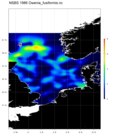
Distribution O. fusiformis mainly occurs north of the 30 m isobath up to the Dogger Bank, with the highest densities in the northern...
Distribution Owenia fusiformis has a limited distribution on the Belgian part of the North Sea: in both periods the species was only...
Distribution Bay of Fundy to Cape Cod
 The webpage text is licensed under a Creative Commons
Attribution 4.0 License
The webpage text is licensed under a Creative Commons
Attribution 4.0 License
Nomenclature
page(s): v.8:31, plate 175 (1844) [details]
original description (of Ammochares aedificator Andrews, 1891) Andrews, Ethan Allen. (1891). Report upon the Annelida Polychaeta of Beaufort, North Carolina. <em>Proceedings of the United States National Museum.</em> 14(852): 277-302, plates XII-XVIII., available online at http://biodiversitylibrary.org/page/7543195
page(s): 296-297, plate XVIII figs. 42-45 [details]

original description (of Ammochares occidentalis Johnson, 1901) Johnson, Herbert Parlin. (1901). The Polychaeta of the Puget Sound region. <em>Proceedings of the Boston Society for Natural History.</em> 29(18): 381-437, plates 1-19., available online at http://www.archive.org/stream/proceedingsbost07unkngoog#page/n436/mode/2up
page(s): 420-421, plate 14 figs. 140-142 [details]
original description (of Ammochares orientalis Grube, 1878) Grube, Adolph-Eduard. (1878). Annulata Semperiana. Beiträge zur Kenntniss der Annelidenfauna der Philippinen nach den von Herrn Prof. Semper mitgebrachten Sammlungen. <em>Mémoires l'Académie Impériale des Sciences de St.- Pétersbourg.</em> (série 7) 25(8): 1-300., available online at https://biodiversitylibrary.org/page/45379218
page(s): 204-205, plate X fig. 6 [details]
original description (of Ammochares tenuis Haswell, 1883) Haswell, William A. (1883). On some new Australian tubicolous annelids. <em>Proceedings of the Linnean Society of New South Wales.</em> 7(4): 633-638., available online at http://biodiversitylibrary.org/page/6462370 [details]
original description (of Ops digitata Carrington, 1865) Carrington, Benjamin. (1865). On the chaetopod annelides of the Southport sands. <em>Proceedings of the Literary and Philosophical Society of Manchester.</em> 4: 176-188., available online at https://biodiversitylibrary.org/page/48862346
page(s): 187-188 [details]
original description (of Ammochares ottonis Grube, 1846) Grube, Adolph-Eduard 1846. Beschreibung neuer oder wenig bekannter Anneliden. Zweiter Beitrag: Corephorus elegans Gr., Ammochares Ottonis Gr., Dasymallus caducus Gr., Scalis minax Gr. Archiv für Naturgeschichte, Berlin, 12: 161-171,plate 5, available online at http://www.biodiversitylibrary.org/page/13704924
page(s): 163-166, plate V fig. 2 [details]
original description (of Owenia brachycera Marion, 1876) Marion, A.F. (1876 [vol for 1875]). Sur les Annélides de Marseille. <em>Revue des sciences naturelles, Montpellier.</em> 4 (1): 301-312, pl. 6., available online at http://biodiversitylibrary.org/page/14526461 [details]
original description (of Owenia filiformis Claparède, 1870) Claparède, Édouard. (1869). Les Annélides Chétopodes du Golfe de Naples. Seconde partie. Ordre II<sup>me</sup>. Annélides Sédentaires (Aud. et Edw.). <em>Mémoires de la Société de Physique et d'Histoire Naturelle de Genève.</em> 20(1): 1-225, plates XVII-XXXI., available online at https://biodiversitylibrary.org/page/14264110 [details]
Taxonomy
 [request]
status source Dauvin, J.C. and Thiebaut, Eric. (1994). Is Owenia fusiformis Delle Chiaje a cosmopolitan species?. <em>Mémoires du Muséum national D'histoire naturelle.</em> 162: 383-404.
note: maintain that Owenia fusiformis is widely distributed [details]
Other
[request]context source (HKRMS) Lam WY. (2007). Response of marine macrobenthic communities upon recovery from organic pollution. Mphil thesis. City University of Hong Kong. [details]
context source (Schelde) Maris, T., O. Beauchard, S. Van Damme, E. Van den Bergh, S. Wijnhoven & P. Meire. (2013). Referentiematrices en Ecotoopoppervlaktes Annex bij de Evaluatiemethodiek Schelde-estuarium Studie naar “Ecotoopoppervlaktes en intactness index”. [Reference matrices and Ecotope areas Annex to the Evaluation methodology Scheldt estuary Study on “Ecotope areas and intactness index”. <em>Monitor Taskforce Publication Series, 2013-01. NIOZ: Yerseke.</em> 35 pp. (look up in IMIS) [details]
context source (BeRMS 2020) Bio-environmental research group; Institute of Agricultural and Fisheries research (ILVO), Belgium; (2015): Macrobenthos monitoring in function of the Water Framework Directive in the period 2007-2009. [details]
additional source McIntosh, William Carmichel. (1915). Polychaeta, Opheliidae to Ammocharidae. <em>A Monograph of the British Marine Annelids.</em> The Ray Society, London, 3 (1): i-viii, 1-368 (text)., available online at https://biodiversitylibrary.org/page/38532650
page(s): 356-364, plate XCII fig. 6, plate CI fig. 8-8f, plate CX fig. 9-9b [details]
additional source Fauchald, K.; Granados-Barba, A.; Solís-Weiss, V. (2009). Polychaeta (Annelida) of the Gulf of Mexico, Pp. 751–788 in D.L. Felder and D.K. Camp (eds.). <em>Gulf of Mexico. Origin, Waters, and Biota. Volume 1, Biodiversity.</em> Texas A&M University Press, College Station, Texas., available online at https://books.google.es/books?id=CphA8hiwaFIC&lpg=PR1&pg=PA751 [details]
additional source Trott, T. J. (2004). Cobscook Bay inventory: a historical checklist of marine invertebrates spanning 162 years. <em>Northeastern Naturalist.</em> 11, 261-324., available online at http://www.gulfofmaine.org/kb/files/9793/TROTT-Cobscook%20List.pdf [details] Available for editors
[request]additional source Helm, Conrad; Vöcking, Oliver; Kourtesis, Ioannis; Hausen, Harald. (2016). Owenia fusiformis – a basally branching annelid suitable for studying ancestral features of annelid neural development. <em>BMC Evolutionary Biology.</em> 16(1)., available online at https://doi.org/10.1186/s12862-016-0690-4
note: larval development [details]
additional source Fauchald, K. (1977). The polychaete worms, definitions and keys to the orders, families and genera. <em>Natural History Museum of Los Angeles County: Los Angeles, CA (USA), Science Series.</em> 28:1-188., available online at http://www.vliz.be/imisdocs/publications/123110.pdf [details]
additional source Integrated Taxonomic Information System (ITIS). , available online at http://www.itis.gov [details]
additional source Bellan, G. (2001). Polychaeta, <i>in</i>: Costello, M.J. <i>et al.</i> (Ed.) (2001). European register of marine species: a check-list of the marine species in Europe and a bibliography of guides to their identification. <em>Collection Patrimoines Naturels.</em> 50: 214-231. (look up in IMIS) [details]
additional source Brunel, P., L. Bosse & G. Lamarche. (1998). Catalogue of the marine invertebrates of the estuary and Gulf of St. Lawrence. <em>Canadian Special Publication of Fisheries and Aquatic Sciences, 126.</em> 405 pp. (look up in IMIS) [details] Available for editors
[request]additional source Gosner, K. L. (1971). Guide to identification of marine and estuarine invertebrates: Cape Hatteras to the Bay of Fundy. <em>John Wiley & Sons, Inc., London.</em> 693 pp. [pdf copepod and branchiuran :445-455]. (look up in IMIS) [details] Available for editors
[request]additional source Linkletter, L. E. (1977). A checklist of marine fauna and flora of the Bay of Fundy. <em>Huntsman Marine Laboratory, St. Andrews, N.B.</em> 68: p. [details]
additional source Day, J. H. (1967). [Sedentaria] A monograph on the Polychaeta of Southern Africa. Part 2. Sedentaria. British Museum (Natural History), London. pp. 459–842., available online at http://www.biodiversitylibrary.org/bibliography/8596 [details]
additional source Muller, Y. (2004). Faune et flore du littoral du Nord, du Pas-de-Calais et de la Belgique: inventaire. [Coastal fauna and flora of the Nord, Pas-de-Calais and Belgium: inventory]. <em>Commission Régionale de Biologie Région Nord Pas-de-Calais: France.</em> 307 pp., available online at http://www.vliz.be/imisdocs/publications/145561.pdf [details]
additional source Augener, Hermann. (1934). Polychaeten aus den Zoologischen Museen von Leiden und Amsterdam. – IV. (Schluss). <em>Zoologische Mededeelingen, Leiden.</em> 17(8): 67-160 [includes figs. 14-31 + figure captions for the 4 issues of the series]., available online at http://www.repository.naturalis.nl/record/318471 [details] Available for editors
[request]additional source Augener, H. (1914). Polychaeta II: Sedentaria. pp. 1-72. In: Michaelsen, W. and Hartmeyer, R. (Eds.). Die Fauna Südwest-Australiens. Ergebnisse der Hamburger südwest-australischen Forschungsreise 1905. Volume 5. Gustav Fischer. Jena.
page(s): 77-79 [details]
additional source Caullery, Maurice. (1944). Polychètes Sédentaires de l'Expédition du Siboga: Ariciidae, Spionidae, Chaetopteridae, Chlorhaemidae, Opheliidae, Oweniidae, Sabellariidae, Sternaspidae, Amphictenidae, Ampharetidae, Terebellidae. <em>Siboga-Expeditie Uitkomsten op Zoologisch, Botanisch, Oceanographisch en Geologisch gebied verzameld in Nederlandsch Oost-Indië 1899-1900 XXIV 2 bis.</em> 1-204.
page(s): 48-52, fig. 41A-G [details] Available for editors
[request]additional source Fauvel, Pierre. (1914). Annélides polychètes non-pélagiques provenant des campagnes de l'Hirondelle et de la Princesse-Alice (1885-1910). <em>Résultats des Campagnes Scientifiques accomplies sur son yacht par Albert Ier Prince Souverain de Monaco.</em> 46: 1-432, 31 plates., available online at https://biodiversitylibrary.org/page/2117722 [details]
additional source Fauvel, P. (1927). Polychètes sédentaires. Addenda aux errantes, Arachiannélides, Myzostomaires. <em>Faune de France Volume 16. Paul Lechevalier. Paris.</em> 1-494., available online at http://www.faunedefrance.org/bibliotheque/docs/P.FAUVEL(FdeFr16)Polychetes-sendentaires.pdf [details]
additional source Hartman, O. (1951). The littoral marine annelids of the Gulf of Mexico. <em>Publications of the Institute of Marine Science, Port Aransas, Texas.</em> 2(1): 7-124., available online at http://hdl.handle.net/2152/22162
page(s): 106-107 [details] Available for editors
[request]additional source Hartman, Olga. (1959). Catalogue of the Polychaetous Annelids of the World. Parts 1 and 2. <em>Allan Hancock Foundation Occasional Paper.</em> 23: 1-628. [details] Available for editors
[request]additional source Imajima, Minoru; Morita, Yoshiko. (1987). Oweniidae (Annelida, Polychaeta) from Japan. <em>Bulletin of the National Science Museum, Tokyo, Ser. A (Zoology).</em> 13(3): 85-102., available online at https://www.kahaku.go.jp/english/research/publication/zoology/v13_3.html
page(s): 87, figures 2 a-k, 4 a-d; note: records for Japan plus description [details] Available for editors
[request] Present Present in aphia/obis/gbif/idigbio Inaccurate Introduced: alien Containing type locality
Editor's comment Biologists should be wary of cryptic species in Owenia, and that not all information recorded under Owenia fusiformis in the past (it was regarded as worldwide) may relate to that species. Deepsea records of O. fusiformis are likely to be misidentifications. [details]
Publication date 1844. [Tome 8 and plates 174-181 were published in 1844 according to Sherborn] [details]
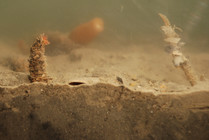
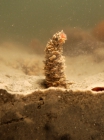
O. fusiformis lives in tubes that are partly buried in the sediment and partly extended from the sediment. It is able to live in low oxygen concentrations for a short time.
O. fusiformis selectively ingests suspended and deposited particles. It feeds by means of the lobed tentacular crown, either in an upright position or bent over to the sediment surface, thereby exposing its anterior part. The species is often found in stomachs of flatfish, haddock and cod (Hartmann-Schröder, 1971; Wolff, 1973; Curtis, 1977; Fauchald & Jumars, 1979; Fish & Fish, 1989; Gentil et al., 1990). [details]
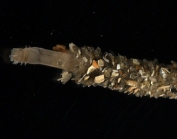
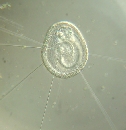
Description Tube-living bristle worm with a cylindrical body up to 100 mm long. The head features a crown of six
short, branched and membraneous gills. The segments number 30 and differ in length. The flexible
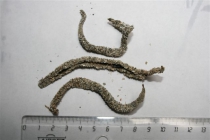
tube of cemented sand grains and shell fragments is longer than the worm itself. The worm is able to
withdraw from the end protruding from the sediment surface, which subsequently bends down. [details]
Distribution O. fusiformis mainly occurs north of the 30 m isobath up to the Dogger Bank, with the highest densities in the northern part of the Oyster Ground. The species is also found in the southern part of the study area, viz. near the coast and in the easternmost part of the Oosterschelde. [details]
Distribution Owenia fusiformis has a limited distribution on the Belgian part of the North Sea: in both periods the species was only observed in the near-coastal zone with the exception of eastern coastal zone. Whereas O. fusiformis was only found in low densities in the 1976-1986 period (maximum 15 ind./m2), densities up to 500 ind./m2 were recorded in the 1994-2001 period. [details]
Distribution Bay of Fundy to Cape Cod [details]
Habitat In the study area O. fusiformis is predominantly found in substrates composed of fine sand with a high mud content, such as occur in the Oyster Ground. The distribution of this species is thought to be determined by temperature (Wolff, 1973). [details]
Habitat Although Owenia fusiformis can be found in fine to coarse sediments (150 to 500 μm) the species only reaches a high relative occurrence in the finer sediments. Sediment has to contain mud to be suitable for O. fusiformis. The highest relative occurrence is reached in sediments with a mud content of 10 to 40%. Owenia fusiformis does not occur in sediments with a mud content exceeding 40%. [details]
Habitat bathyal, infralittoral and circalittoral of the Gulf and estuary [details]
Morphology A species with a long, cylindrical body lacking parapodia. The frontal end of the body consists of a circle of short, fringed tentacles. The maximum length amounts to 50 mm with 30 segments. The body is greenish or yellowish, with paler transverse bands. The tube is characteristic, tapering towards one end and composed of overlapping shell fragments or sand grains (Fager, 1964; Fish & Fish, 1989; Hartmann-Schröder, 1971; Hayward & Ryland, 1990). [details]

| Language | Name | |
|---|---|---|
| English | tubeworm | [details] |
| German | spindelförmige Owenie | [details] |
| Japanese | チマキゴカイ | [details] |
Marine Life Information Network - UK
PlanktonNet Image
To Barcode of Life (306 barcodes)
To Biodiversity Heritage Library (3 publications) (from synonym Ops digitata Carrington, 1865)
To Biodiversity Heritage Library (40 publications) (from synonym Owenia filiformis Claparède, 1870)
To Biodiversity Heritage Library (95 publications)
To Biological Information System for Marine Life (BISMaL)
To European Nucleotide Archive, ENA (Owenia fusiformis)
To GenBank (2165 nucleotides; 31198 proteins)
To Global Biotic Interactions (GloBI)
To PESI
To The Arctic Traits Database (15 traits)
To USNM Invertebrate Zoology Annelida Collection (1 record) (from synonym Ammochares aedificator Andrews, 1891)
To USNM Invertebrate Zoology Annelida Collection (351 records)
To ITIS